
Art Therapy for Trauma
Trauma doesn't always live in the parts of you that have words. It shows up in the body — the tight chest, the sleep that won't come, the reaction that's two sizes bigger than the moment that triggered it. Art therapy for trauma works there. In our Brooklyn space, you make marks before you have to explain them, and the explaining gets easier when your nervous system isn't doing it alone. We offer trauma therapy in Brooklyn and virtually that pairs licensed art therapists with EMDR - both inherently somatic practices.
What Is Trauma-Focused Art Therapy?
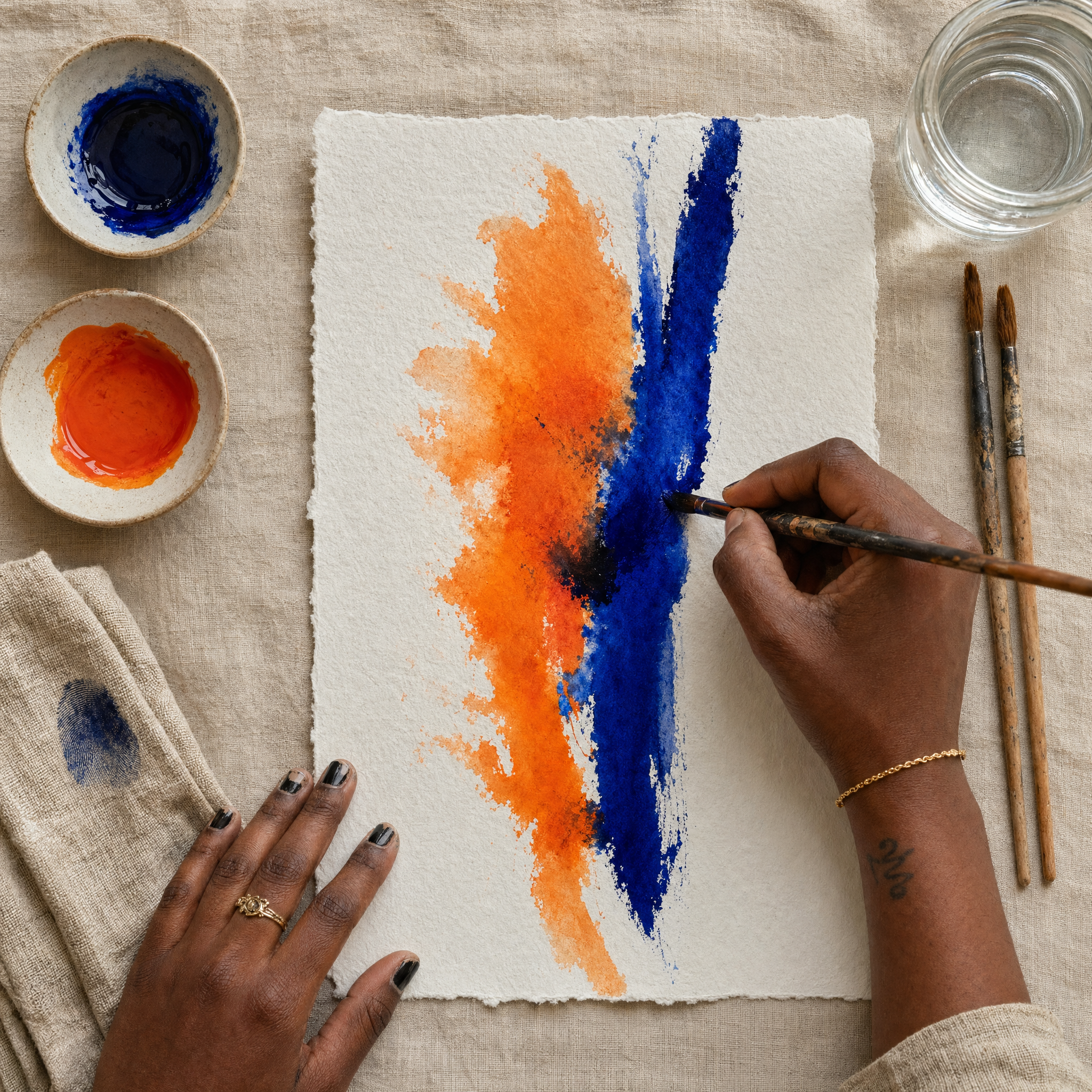
Trauma-focused art therapy is a clinical practice in which a licensed art therapist assists their clients in art-making — drawing, paint, clay, collage — alongside verbal work to help you access and integrate experiences that don't always come out as sentences. The therapist isn't a teacher, and they aren't grading anything. They're trained to read what shows up in the materials and help you make sense of it, at the pace your nervous system can actually keep up with.
Our therapists are registered art therapists (ATR / ATR-BC) and licensed creative arts therapists (LCAT). That credential matters: it means we practice trauma-informed art therapy as a clinical specialty — not art-as-self-care. Here's why that distinction matters for trauma specifically.
A lot of people who land on this page have already done talk therapy. Sometimes years of it. They can describe what happened. They can name the patterns. And yet they're still flinching at the same things. That's not a failure of effort or insight. Trauma is stored in the body and in non-verbal memory — places where language can't fully reach. When the words have been worn smooth from re-telling, the work has to move into a different channel. Art therapy gives you that channel.
The art therapy techniques for trauma we use aren't crafts, and they aren't free expression. They're clinically chosen directives: body maps for where the trauma sits in the body, containment imagery for what is too overwhelming to manage right now, bilateral drawing for nervous system regulation. A session might lean on structured exercises one week and open art therapy prompts the next; some weeks the work happens away from paper entirely. The therapist tracks your body and paces accordingly.
Art therapy can feel weird at first. So can EMDR. Both are worth it.
A 2024 multi-baseline clinical study found that trauma-focused art therapy produced measurable reductions in PTSD symptoms across participants.
When Talking About It Hasn't Been Enough
Trauma We Work With
Complex trauma (C-PTSD)
Chronic, often relational. The kind that took years.
PTSD & acute trauma
A single event the nervous system hasn't filed away.
Childhood & attachment wounds
What got installed before you had words to question it.
Interpersonal & work-stress trauma
Toxic workplaces, burnout, ruptures that left a mark. It counts.
Identity-based trauma
Racism, transphobia, homophobia, body-based and religious harm. We are queer-affirming, anti-oppressive, & utilize a HAES approach.
Schedule a free 15-minute appointment
Art Therapy + EMDR Together
EMDR
Evidence-based reprocessing of traumatic memories so they stop running the present.
Art Therapy
A non-verbal channel for unconscious material, and for memories that words can't carry.
↳ Together ↲
Several of our therapists are trained in both. Some clients choose one. Some weave both. We figure out the fit in your free consult.
Not sure which fits? See how art therapy and EMDR compare.
Art Therapy for PTSD: CPTSD, Attachment Trauma, and Single-Event PTSD
PTSD is one of the shapes trauma takes — specifically, what your nervous system started doing after the event, or after the years, didn't end. Flashbacks, hyperarousal, avoidance, the body still responding like it's all happening right now. Art therapy for PTSD works underneath language, where most of it lives.
We see three rough shapes, and most of what people bring in is one of these or a combination.
Single-event PTSD. A car accident, an assault, a medical emergency, a sudden loss. The kind of trauma with a clear before-and-after. The work focuses on building enough safety to be near the memory without going back into it, and on returning a sense of your own continuity afterward.
Complex PTSD (CPTSD). A childhood you couldn't leave, a long relationship that wore you down — trauma over years, not in a moment. The ICD recognizes complex PTSD as a formal diagnosis; the DSM doesn't, yet. We treat it as real because it presents differently and responds to slower, longer work.
Attachment trauma. When the wound is about who was supposed to be safe. Caregivers, early bonds, the way it shows up later in relationships and self-worth. Often sits inside the CPTSD category; sometimes it stands on its own.
For PTSD specifically, art therapy and EMDR work well together — EMDR for reprocessing the part of the memory that’s still active in your body, art therapy for stabilization and integration. Many of our trauma therapists in Brooklyn are trained in both. If you want a deeper read on EMDR, see our EMDR therapy page.
When trauma surfaces as chronic worry or panic, our art therapy for anxiety page describes how we approach the anxiety layer specifically. Artists and creative professionals carrying creative-industry-specific trauma can read more on therapy for artists.
Frequently Asked Questions about
Art Therapy for Trauma
-
No. The art carries what doesn't have words yet. You set what gets discussed and when.
-
A trained therapist paces the work to keep you inside your window of tolerance. Re-experiencing isn't the goal. Integration is.
-
The art therapy activities for trauma we draw from are evidence-supported directives — body maps, containment imagery, bilateral drawing, resource imagery. Some are structured exercises designed to settle the nervous system; others are open-ended invitations. Your therapist chooses based on what your body is asking for that session.
-
Talk therapy works through language. Art therapy adds a non-verbal channel — useful when memory is pre-verbal, somatic, or worn smooth from re-telling.
-
Yes. Several therapists on our team are trained in both. We discuss what fits your case in the free consult.
-
Yes. Skill is irrelevant. The mark-making is a clinical tool, not a performance.