
Art Therapy for Anxiety
Anxiety doesn't have edges. It loops. It runs in your body before you've named it, and by the time you do, it's already moved somewhere else. You know all this. You've probably read the books, tried the breathing, done the work of figuring out what triggers what. And it still won't slow down.
Art therapy works on a different floor of the same building. It doesn't ask you to explain the loop — it asks you to put it somewhere outside your body, on paper or in clay, where it has a size you can actually see. Making something when you're already overwhelmed can feel like one more ask. We know. That's also part of why it works.
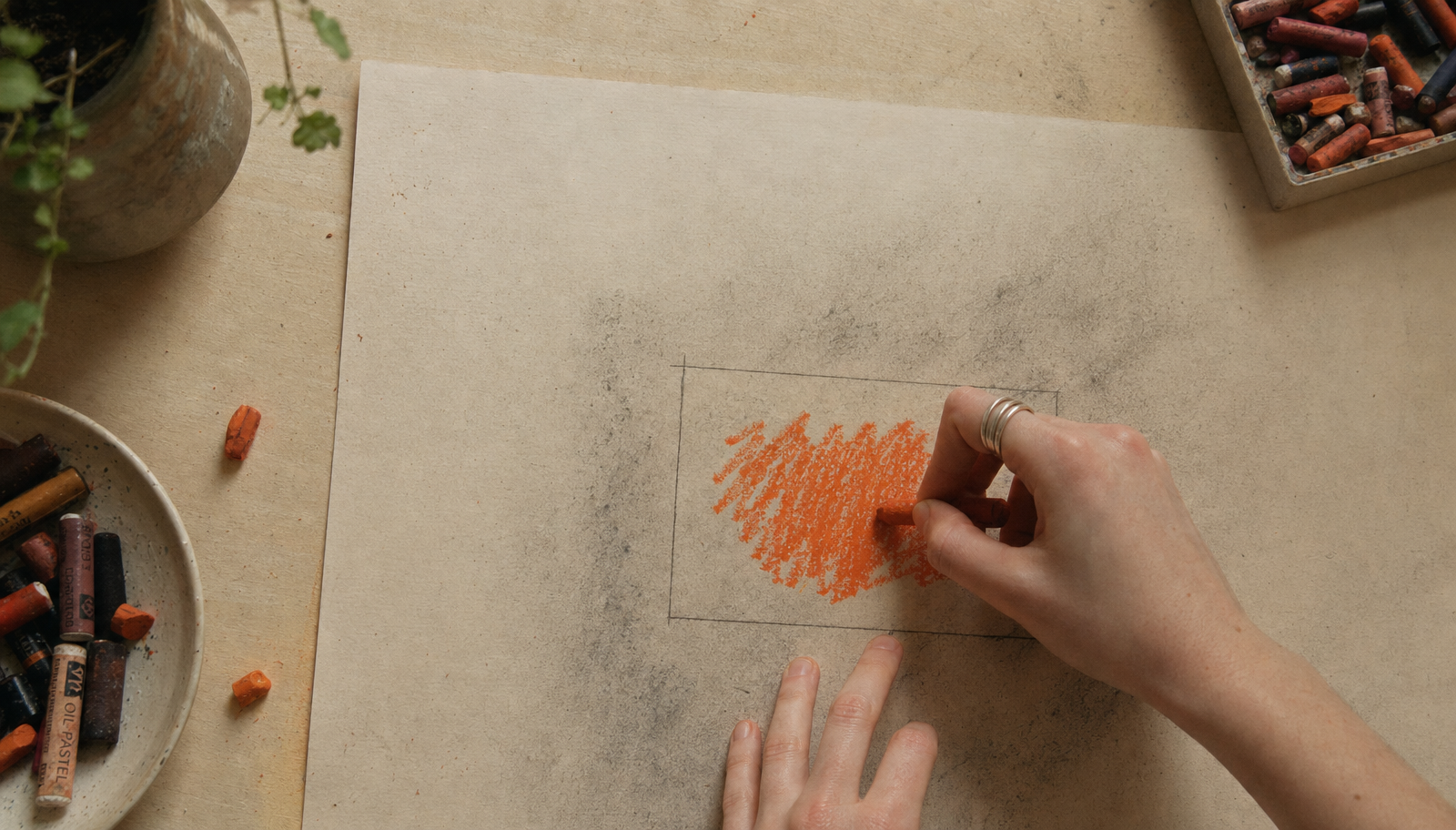
What Art Therapy for Anxiety Actually Does
Anxiety, structurally, is the feeling of having no container. The body is doing too much at once and there's nowhere for it to land. Art therapy gives the feeling a container: the page, the material, the directive, the room itself. None of these are metaphors — they're literal edges where the feeling can sit instead of running.
You don't have to be good at art. You don't have to make anything anyone would want to look at. The work is what happens between you and the material — the part where something inside you finally has somewhere to go.
If you're reading this, you've tried things. CBT, probably. A meditation app or two. Maybe a stretch of medication that helped some, helped less, or never quite landed. The thinking parts of you know more about your anxiety than most people do. And there's still this part of your body that won't stop bracing. This loop that runs while you're trying to fall asleep. This feeling that comes from your throat instead of your head.
The reason talking alone sometimes doesn't move it is that anxiety isn't only cognitive. It lives in muscle, breath, posture — the way your jaw sits when you're not thinking about it, the way your shoulders ride up half an inch by 3 p.m. and stay there. Working with material — pressing into clay, dragging color across a page, watching paint bleed where you didn't expect it — gives those somatic parts of you a way into the work. You don't have to argue with the loop. You can just put it down.
The research backs the somatic angle. A randomized controlled trial in Frontiers in Psychology studied adult women with elevated anxiety who received art therapy compared to a waitlist control. The art therapy group showed large reductions in anxiety and large improvements in subjective quality of life, alongside a medium effect on emotion regulation — specifically, on how accessible their regulation strategies felt to them under stress. The finding lines up with what shows up in the room: when anxiety lives below language, working below language is what moves it.
When Talking Hasn't Slowed It Down
Three techniques come up often, used in whatever combination fits the session and the person.
Making it smaller. When something feels enormous, we draw it. Not the whole thing — a small, dense version of it on a small square of paper. The act of containing it visually is the act of containing it in the body, too. Anxiety the size of an index card is a different animal than anxiety the size of your whole life.
Externalizing the loop. If a thought is running in circles, we put it on the page so it can run there instead of in you. Sometimes that means writing the worry inside a shape. Sometimes it means making a mark every time the thought reappears, watching it accumulate as texture. The point isn't to fix the thought — it's to set it down.
Somatic anchoring through material. Clay resists. Charcoal smudges. Watercolor pools where you don't expect it. Working with material that has weight and pushes back gives your nervous system something to track that isn't the loop. This is grounding, not as a coping skill, but as a felt experience.
How We Work With Anxiety in the Room
Schedule a free 15-minute appointment
When Anxiety Has Trauma Underneath
Not all anxiety is trauma-related. Some of it is wiring, some of it is environment, some of it is the year you're having. But for some people, what looks like anxiety on the surface is the nervous system carrying something older — a single event, a long stretch of being unsafe, an early attachment that didn't feel solid.
If that's part of your picture, the work shifts. We pair art therapy with EMDR for the trauma-rooted part, and the art therapy work continues to do what it does — making it smaller, externalizing, grounding. You can read more on our pages on trauma-focused art therapy and EMDR.
Frequently Asked Questions about
Art Therapy for Anxiety
-
Self-care art is wonderful, but it's not what we do. We're licensed creative arts therapists (LCAT), trained in clinical work. The materials are similar; the work is structurally different. We're using art as a way into clinical change, not as a way to relax.
-
Sometimes feelings get louder before they get smaller — that's true of any therapy. Our job is to titrate the work so you stay inside your window. We're not interested in flooding you.
-
Roughly: we check in, we talk for a bit, we work with material for a stretch, and we talk about what came up. The proportions shift session to session. Some sessions are mostly making. Some are mostly talking with materials nearby. You don't have to make something every time.
-
We accept some insurance plans and offer out-of-network superbills for others. Self-pay rates are listed on our fees page. Reach out and we'll walk you through what your plan covers. If you want a lower-cost way in, our in Greenpoint are private pay and need no ongoing commitment.
-
Yes. In that case we usually integrate trauma-focused art therapy and sometimes EMDR. The anxiety work and the trauma work happen together, not in sequence.
-
It depends on what your anxiety is doing that day. Often it's one of the moves above — making the worry smaller, externalizing the loop onto paper, or somatic anchoring through material like clay, charcoal, or watercolor. Art therapy activities for anxiety aren't generic worksheets, and art therapy exercises for anxiety aren't homework you have to complete between sessions. The directive is chosen in the moment, with you, based on what's actually showing up in your body when you sit down.