
Art Therapy Techniques
If "art therapy techniques" makes you picture worksheets — color-by-emotion exercises, fill-in-the-blank prompts, the kind of thing you'd find on a clinic waiting-room PDF — that's a fair guess, but it’s not what we mean. In art therapy, technique is closer to structure: how a therapist sets up (or doesn't set up) the making during a session.
There are three main approaches, and we move between them depending on your needs in therapy - or even what you’re bringing in that day. Here's what each one actually looks like in the room.
The three categories of art therapy techniques
Art therapy techniques fall into three categories: directive (the therapist offers a specific prompt), non-directive making (you make without a prompt, with the therapist present — sometimes called the open-studio approach), and between-session work (you make something at home and bring it in for conversation). Most sessions use directive work — somewhere around ninety percent of the time — but a fluent practice moves between all three.
The choice isn't aesthetic. It's clinical. A directive helps when you're stuck and need a way in; a non-directive approach helps when the work needs to find its own shape; between-session work helps when something keeps coming up between visits and needs a place to land.
Directive techniques
A directive is a specific prompt: draw a house, a tree, and a person, or make something that represents how the conversation with your mother felt last week. The therapist offers the prompt because of what you're working on — not because there's a script.
This is the most common kind of work, and it splits into two flavors.
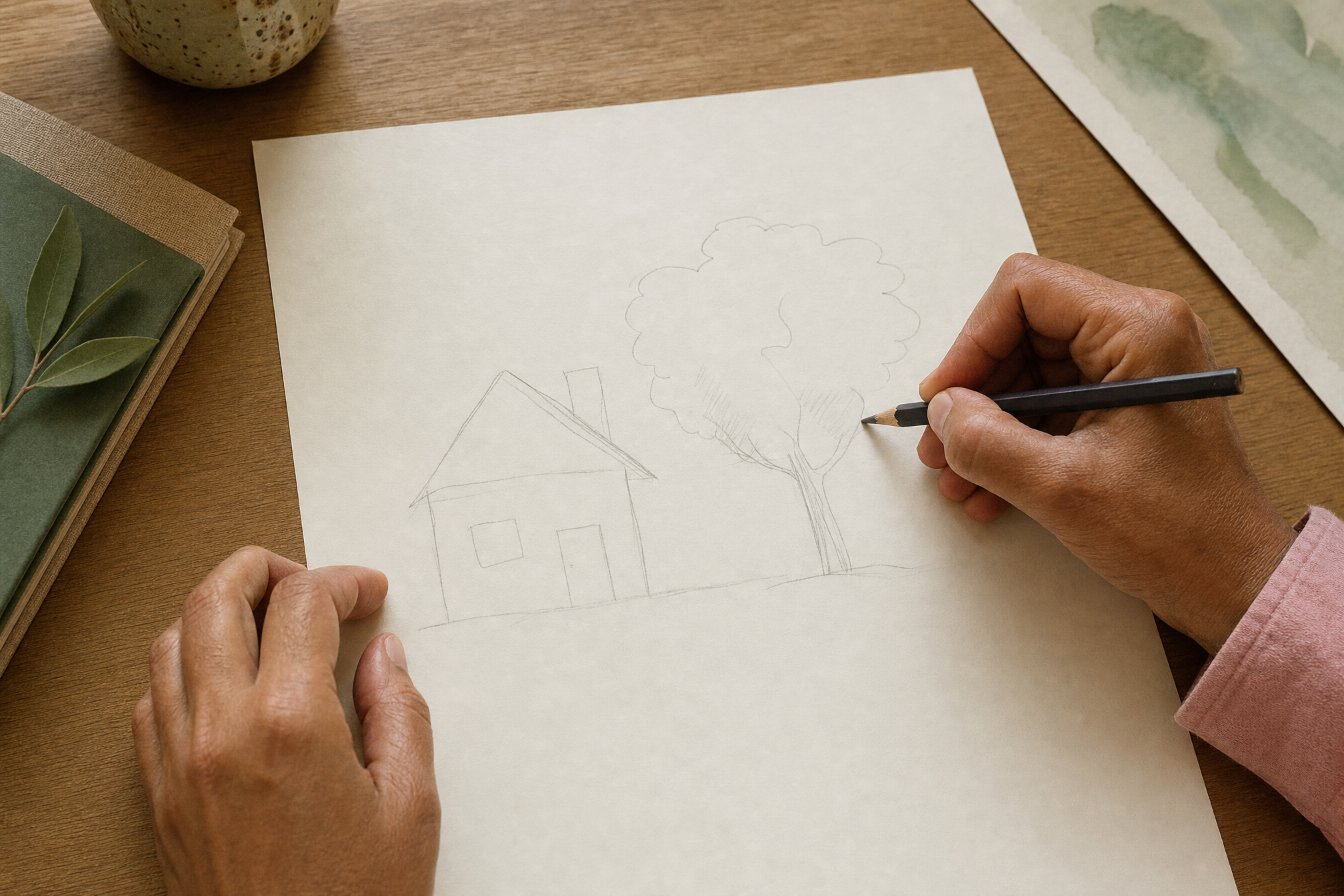
Traditional directives
Some directives are old enough to have names. House-tree-person (HTP) was developed by John Buck in 1948 and asks for a freehand drawing of each of the three subjects. Bridge drawing, introduced by Hays and Lyons in 1981, asks you to draw a bridge "from someplace to someplace" — the resulting image tends to surface how you imagine moving from past to present to future, what stands in the way, what's holding you up.
These are useful tools. They are not diagnostic tests. The contemporary evidence on projective drawings as standalone assessments is thin, and good clinicians (us included) use them the way they're best used: as conversation-starters, a way to notice what shows up.
Creative directives
The rest of the time, the directive is built on the spot for what you brought in. Represent how it felt to be at that family dinner. Make a piece for the part of you that's been carrying this all week. Use only the colors that feel like rest.
These directives are responsive. They're shaped by what you've already said, what you keep returning to, what you can't quite get into language. A creative directive isn't a worksheet — it's a question, asked in a different grammar.
When directive work helps with anxiety, trauma, or stuck points
For anxiety, a directive offers a container — the page has edges, the prompt has shape, and the spinning has somewhere to land. For trauma work, a directive opens a door to physical expression when language can't carry the weight — hands moving across paper, marks on a page, the body saying what words can't reach. For stuck-points — the kind where you keep circling the same conversation week after week — a directive offers a different angle, often one that surfaces something language has been protecting you from.
Recent research backs this up. A 2024 systematic review and meta-analysis of visual arts therapy for traumatic experiences found significant reductions in PTSD and depression symptoms. A 2025 meta-analysis of visual art therapy for anxiety in adults — covering 35 studies — found a significant effect on anxiety symptoms. The evidence is real, even if the field is still working out which techniques work best for whom.
Non-directive making
Non-directive making — sometimes called the open-studio approach in art-therapy literature — is what it sounds like: no prompt. You come in, the materials are out, you make what wants to be made, the therapist is present and noticing. There's still a session structure — a beginning, a middle, an end, and a conversation throughout — but the making isn't pre-shaped.
This works well when something is already moving and a prompt would interrupt it. It works well for people who've been over-directed in their lives and need an honest space to choose. It works well when the body knows what to make before the mind has named what's happening.
The risk of non-directive work is the same as its strength: nothing keeps you on the page. A good therapist holds the structure even when the prompt is absent.
Between-session work
Sometimes the most important art-making happens between sessions. You're walking home, something the conversation surfaced keeps pulling at you, and by Wednesday you've made a small piece on your kitchen table. You bring it in to the next session.
What that piece opens is often different from what gets made in the room. Home pieces tend to carry more privacy — they're made without an audience, even an attuned one. The conversation we have about them isn't usually about the work itself; it's about what you were inside while you made it, what you reached for when you were alone, what surprised you when you saw it finished.
Not every client does this. We never assign it (unless requested). But when it shows up on its own, we make room for it.
How a therapist picks the technique for the session
Honestly: we read the room.
You walk in, you say what's happening, we listen for what kind of container the day needs. Sometimes it's clear in the first three minutes — you're flat and tight and a directive would offer some structure. Sometimes it takes longer — you're already saying something the materials would say better, and the question is what to set out. Sometimes we don't make anything at all and the hour is talk, and that's the right call.
The technique serves the session. It is never the goal.
What these techniques are not
They are not exercises to complete. They are not graded. We are not going to look at your bridge drawing and tell you what's wrong with your childhood. The mess is the point — the smudged charcoal, the color you didn't mean to choose, the part you tried to scrub off and couldn't.
If you've ever wondered what an art therapist is before you book one, that's worth reading too. For people whose stuck point sits closer to trauma than language can reach, we sometimes pair art therapy withEMDR — the two approaches can hold each other well.
FAQs
-
There are three: directive (the therapist offers a specific prompt), non-directive making (you make without a prompt, also called the open-studio approach), and between-session work (you make something at home and bring it in). Sessions can be a mix, but directive is the most common.
-
HTP is a projective drawing technique developed by John Buck in 1948. The therapist asks you to draw a house, a tree, and a person — each freehand. The conversation that follows is the actual work; the drawings themselves are a doorway.
-
Introduced by Hays and Lyons in 1981, the bridge directive asks you to draw a bridge "from someplace to someplace." What you draw tends to surface how you imagine moving between past, present, and future — where the obstacles are, what's holding you up.
-
The evidence base is real and growing. Recent meta-analyses show significant effects for visual arts therapy on PTSD, anxiety, and depression symptoms. The literature is still smaller than for some other modalities, and individual projective tools have more limited empirical support than the modality as a whole.
-
You can make art on your own — and you should, if it helps. But art therapy as a clinical practice requires a trained therapist holding the work with you. The technique alone isn't the therapy; the relationship is.
