
What Is an Art Therapist?
Most people think they know — and most of the time they're picturing something closer to a craft class than therapy. Or a person who works with kids in a hospital. Or someone who reads your drawing like an oracle. Therapy is hard, and art therapy can feel weird from the outside. Both are worth understanding before you write either one off.
The short version: an art therapist is a licensed psychotherapist who happens to work with art materials. The clinical training is the same depth as any master's-level therapist's — sometimes more — and the art-making is one tool inside a session, not a substitute for the talking. If you've ever been told to "just journal" and felt your shoulders climb up to your ears, this is the version that meets you somewhere words don't.
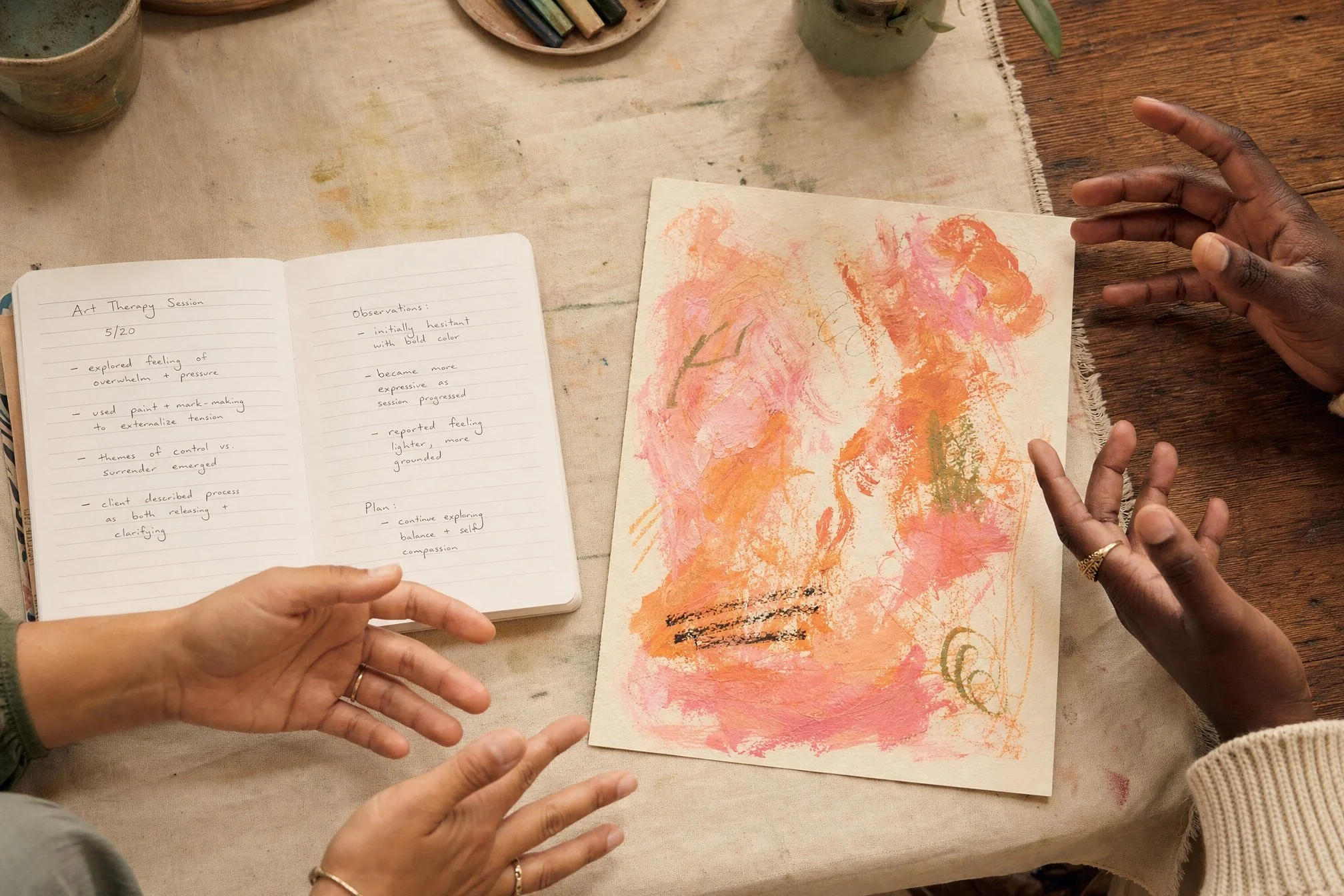
What an art therapist actually is
An art therapist is a master's-trained mental health clinician who uses making — drawing, painting, clay, collage, whatever's in the room — as part of a psychotherapy practice. They are not art teachers. They are trained to hold a therapy hour the same way any other psychotherapist is, with the addition of knowing how to work with what the materials surface.
The making is never the point on its own. The making is a way in.
The training behind the title of an art therapist
This is the part most people don't realize. To call yourself an art therapist in any meaningful sense, you complete a graduate program — typically 60 credits, with 600 hours of practicum and internship. You enter that program already holding 18 semester credits of studio art and 12 of psychology, including developmental and abnormal. After the master's, you complete 1,500 hours of supervised post-graduate work, of which 1,000 are direct client contact and 100 are supervision — 50 of those have to be with a board-certified art therapist. Then you sit for a national exam to earn the ATR-BC credential through the Art Therapy Credentials Board. The whole training & licensure process takes at least 3 - 5 years.
On top of that — depending on the state — some art therapists also hold a separate counseling or social-work license, and many have completed other training programs & certifications.
So when we say an art therapist is a real therapist, we mean: there's a credential, a national exam, supervised clinical hours, and continuing education behind it. It's not a weekend certification.
What an art therapist does in a session
Mostly, we talk. A session looks more like therapy than like an art class. There's intake, a working relationship, goals, the slow excavation of whatever you came in carrying. Materials show up when they help — sometimes for the full hour, sometimes for fifteen minutes, sometimes not at all.
When the materials are out, the work might look like:
A directive — a specific prompt your therapist offers because of what you're working on this week.
An open space to make whatever wants to be made, with the therapist present and noticing.
Something you made at home that you bring in to talk about together.
Nothing is graded. Nothing is critiqued. We're not looking at whether your tree looks like a tree. We're noticing what it felt like to make, what you reached for, what you couldn't stop changing, what the work is saying that you haven't said yet.
Who art therapy is for
Adults. Teens. Couples. Groups. Artists who've stopped making, and people who haven't picked up a pencil since middle school. It's not a kids-only field — that's a leftover association from where art therapy first showed up publicly, in schools and hospitals.
What art therapy does especially well: it gives the body something to do while harder material surfaces. For people working with anxiety, complex trauma, grief, identity work, eating disorders, or the kind of stuck-point where talk-only therapy keeps circling — the materials open a different door. If words are the problem, a different language sometimes helps. Weighing trauma approaches? See art therapy vs EMDR for trauma.
That said: you do not need to be "creative," and you don't need any art skill. The mess is the point. The discomfort of making something imperfect is part of what we work with.
How an art therapist reads the artwork
This is where people get nervous — is my therapist going to analyze my drawing and tell me what's wrong with me?
No. Assessment is part of the training, but it's collaborative, not diagnostic. We're not pulling out a key and decoding your work. We're asking you what you notice, what surprised you, where you got stuck, which colors you reached for and which you avoided. The interpretation belongs to you. We're trained to listen for what's load-bearing.
There are some formal projective tools an art therapist might use — house-tree-person, bridge drawings, family drawings — but the contemporary evidence on these as standalone diagnostic tools is mixed, and good practice treats them as conversation-starters, not tests.
Art therapist vs. art teacher vs. counselor
A quick disambiguation, because the terms get muddled:
An art teacher teaches skill. The goal is your competence with the medium.
An art instructor or workshop facilitator holds a creative space, sometimes with therapeutic benefits, but isn't licensed for clinical work.
A counselor or LCSW offers talk therapy with full clinical training and licensure, but isn't trained in working with materials inside a session.
An art therapist is trained in both — the clinical work and the materials — and licensed to practice psychotherapy.
If you're looking for therapy and someone says they "do art therapy" without naming the credential, ask. The credential is LCAT (Licensed Creative Arts Therapist, specific to NY state/region), or ATR-BC (board-certified art therapist)/ATR-LP (limited permit, on the path to ATR-BC).
Working with an art therapist in Brooklyn
If you're looking for an art therapist near you and you're in Brooklyn, that's us. We're a small practice of clinicians who came up as artists ourselves — we make things too — and the room reflects that. Plants, natural light, real artwork on the walls, somebody who actually gets why this is hard.
If you're an artist working through a creative block alongside everything else, we hold space for that specifically.
Meet the team — we'd rather you know who you'd be sitting with before you book.
FAQs
-
Yes. An art therapist holds a master's degree in art therapy, completes 1,500 hours of supervised post-graduate clinical work, and passes a national board exam to earn the ATR-BC credential. Many hold further certifications and have completed further trainings as well.
-
No. Skill is not the point — and in many cases, being "good at art" can get in the way. The work is about what the making surfaces, not the finished object.
-
An art therapist is trained as a psychotherapist and in working with materials inside the session. The therapy hour is the same depth; the difference is that an art therapist has the option to bring the materials in when language alone isn't reaching what needs to be reached.
-
No. Art therapy works with adults, teens, couples, and groups. The association with kids comes from where the field first showed up publicly — schools, pediatric units — but the practice has always served all ages.
-
A 60-credit master's program (with 600 hours of practicum and internship), 1,500 hours of supervised post-graduate work, and a national board exam. This process takes at least 3 - 5 years.
-
Look for ATR-BC (board-certified), ATR-LP (limited permit), or LCAT (specific to NY state). You can verify credentials through the Art Therapy Credentials Board. If they're practicing as a psychotherapist, they should also hold a state clinical license.
