
Art Therapy vs EMDR
If you're comparing art therapy vs EMDR for trauma, the short version is this: both are recommended, both look nothing like talk therapy, and they reach the work in very different ways.
A note up front: a lot of online comparisons of "ART vs EMDR" are actually about Accelerated Resolution Therapy, which uses the acronym ART. That's a different modality — it uses eye movements and guided imagery and doesn't involve making art. This piece is about art therapy (the creative-arts version) versus EMDR.
The honest answer to which one is right for me? is that it depends on what you need right now, and the most useful thing we can do is walk through how they actually differ. Therapy is hard. Both of these are worth understanding before you choose.
Art therapy vs EMDR: the short answer
EMDR is structured and protocol-driven. Art therapy is exploratory and discussion-led. EMDR follows an eight-phase sequence designed to desensitize and reprocess a specific traumatic memory; art therapy uses making — drawing, painting, clay, collage — as a way to surface and work with material that hasn't found its way into language yet. Both can be the right call. They're often the right call together.
| Art therapy | EMDR | |
|---|---|---|
| What it is | Exploratory, discussion-led making — drawing, painting, clay, collage | A structured 8-phase protocol using bilateral stimulation |
| Best for | Complex, relational or diffuse trauma; identity and grief work; when talk therapy has hit a wall | Single-event trauma; a clear, nameable stuck-point memory |
| How the room feels | Hands busy, conversation, something physical to take away | Still, quiet, interior — guided through a process |
| Evidence base | Real and growing; meta-analyses show reduced PTSD and depression symptoms | Large; endorsed by the WHO, APA and VA for PTSD |
| Typical length | Open-ended — shapes around the client | ~5–15 sessions for a specific memory |
| Talk about the trauma? | Often surfaces before words | Held in mind, not narrated in detail |
What EMDR is, in plain terms
EMDR — eye movement desensitization and reprocessing — was developed by Francine Shapiro in the late 1980s. It's recognized by the World Health Organization, the American Psychological Association, and the U.S. Department of Veterans Affairs as a frontline treatment for PTSD.
The work follows an eight-phase protocol. After history-taking and preparation, the therapist asks you to hold a specific traumatic memory in mind while engaging in bilateral stimulation — typically either following the therapist's hand with your eyes or tapping your shoulders with your arms crossed, though other forms can be used as well. The protocol moves through desensitization, installation of a positive belief, body scan, and closure.
What this is like in the room: structured. Quiet. Less open sharing than you might expect — you don't have to narrate the trauma in detail for the work to happen. The therapist functions more like a guide running you through a process than a conversation partner. People often describe it as both intense and oddly contained.
EMDR tends to be a strong fit for people who: experienced a single-event trauma; experience a repeated cycle of feelings & thoughts that you suspect may have roots in early childhood; can tolerate holding those feelings/images and want a direct approach.

What art therapy is, in plain terms
Art therapy uses materials inside a psychotherapy session. There are three main approaches — directive prompts, non-directive art making, and between-session work — but the unifying logic is that the materials surface what words protect.
What this is like in the room: exploratory. There's making, and there's talking about the making, and the conversation moves between them. The therapist is not running you through a script. The session shapes itself around what you brought in.
The evidence base is real and growing. A 2024 systematic review and meta-analysis of visual arts therapy for trauma found significant reductions in PTSD and depression symptoms across studies. A separate 2024–2025 meta-analysis of creative arts therapy for PTSD reached similar conclusions. The data is smaller and more heterogeneous than the EMDR literature — we'll say that plainly — but it points in the same direction, & the research continues to grow.
When art therapy tends to be a strong fit: complex or diffuse material, relational trauma, identity work, grief that can't be put into words, anyone who has hit a wall with talk-only therapy and needs a different language.
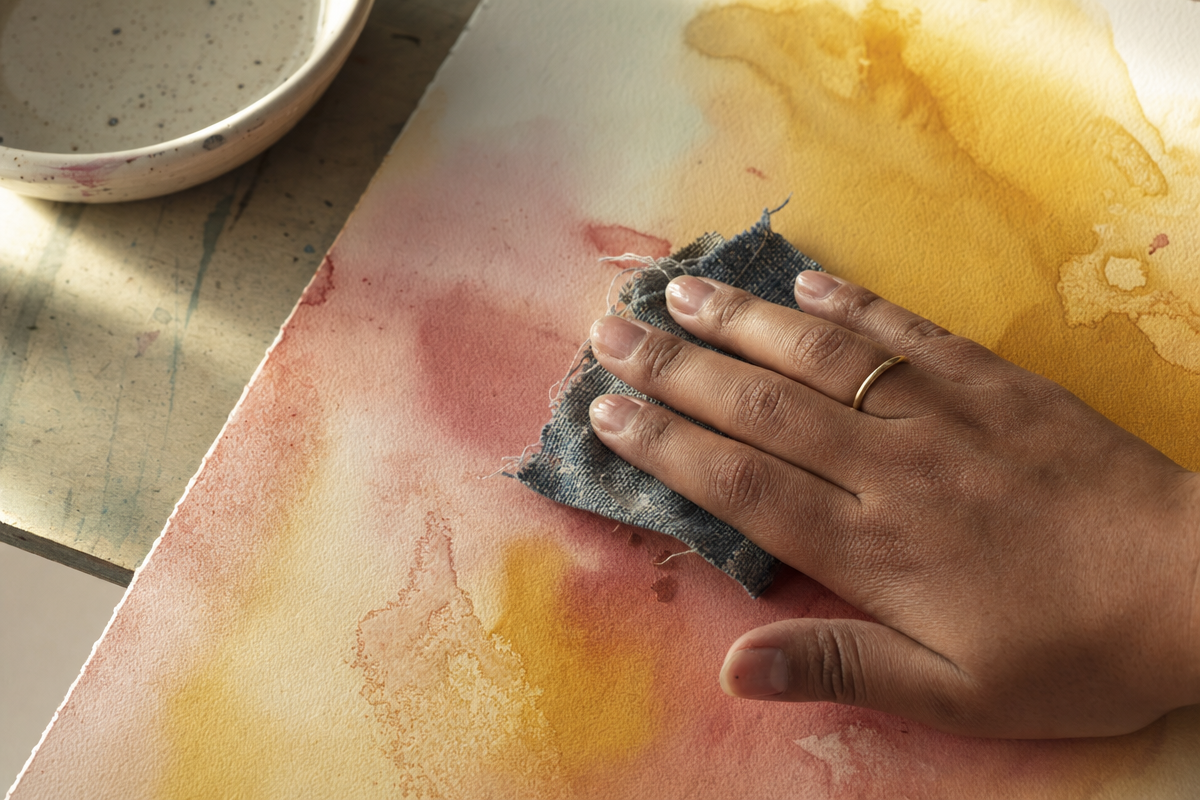
How the room feels different
In an EMDR session: you're often sitting still. Eyes following a moving hand or a light bar, or arms crossed with gentle shoulder tapping. The room is quiet. The work is interior, even when it's intense — you'll often close the session feeling tired in a specific way, like you've been moving without moving.
In an art therapy session: you're working with your hands. There's the sound of charcoal on paper, water in a jar, scissors. There's conversation. The work is happening in front of you, on the page or the table, and you can see it shift. You'll often close the session with something that feels revealing but safe; you can take it with you or leave it with us to hold.
Neither is better. They're different ways of arriving at the same kind of work.
EMDR vs Art Therapy For Trauma: Which to Start With
If you came here hoping for a flowchart, the honest version is closer to this:
Lean EMDR when there's a discrete event or series of experiences you can name, you can tolerate holding the memory, you want direct & swift relief, and you're more comfortable with structure than with mess.
Lean art therapy when the material is diffuse — relational, identity-based, grief that has no single moment to point at — when language has been part of the problem, or when you've already done a lot of talking and need a different way in.
Consider both, in sequence or alongside each other, when the trauma is complex and a single approach feels too narrow.
Here is a simple scenario-based choice tree:
Name a single event and want a direct, structured approach → start with EMDR
Trauma is diffuse/unknown, or grief with no single moment (or talking hasn't reached it) → start with art therapy
It's complex and one lane feels too narrow → combine them, in sequence or side by side
There is no hierarchy here. EMDR has the larger evidence base for single-event PTSD; that's true and worth naming. Art therapy holds material that resists protocol. Both can be the right call.
Are art therapy and EMDR similar?
Not really. They share a willingness to work below the level of language, and they share a recognition that talk therapy alone doesn't reach everything — but the how is genuinely different. EMDR is a defined protocol that any trained EMDR clinician should run consistently. Art therapy is a modality with techniques inside it, and what happens in the room depends on the therapist, the client, the day.
Can you combine art therapy and EMDR
Yes — and there's real clinical literature on it. A 2021 paper in the International Journal of Art Therapy by Talwar and Davis describes two clinicians — one offering art therapy, one offering EMDR — working together on complex childhood trauma, and how the two modalities held each other through the work. The combination supported emotional regulation and interoceptive awareness in ways neither alone could.
In our practice, some clients begin with art therapy to build the relationship and surface the material, then add EMDR sessions to work with specific memories that have become identifiable. Others start with EMDR for a clear stuck-point and use art therapy alongside it to hold what comes up between sessions. There isn't one right order.
What to ask before booking
Whichever direction you go, ask:
What's the clinician's training & experience in this specific modality?
How many sessions do they typically run before reassessing?
What does the first session look like?
What's their stance on combining modalities?
Do they take your insurance, or offer a sliding scale?
Not every practice will combine the two. Ours does — by design. If you want to talk through which one fits your situation, reach out or meet the team and we can take it from there. For trauma specifically, our trauma page walks through how we think about pacing and approach. The fastest way to find the right fit is a free consultation — we'll talk through which approach, or combination, makes sense for you.
FAQs
-
EMDR is a structured eight-phase protocol that uses bilateral stimulation to reprocess specific traumatic memories. Art therapy is an exploratory modality that uses making — drawing, painting, clay — as a way to surface and work with material in a psychotherapy session.
-
EMDR has the larger evidence base for single-event PTSD and is endorsed by the WHO, APA, and VA. Art therapy has a growing evidence base, especially for complex and relational trauma. Neither is universally better; they suit different presentations & needs.
-
Yes. A 2021 paper in the International Journal of Art Therapy describes combining both for complex childhood trauma, with each modality holding what the other couldn't reach alone. In practice, the two often work well in sequence or in tandem.
-
Complex trauma — relational, developmental, prolonged — responds well to both art therapy and EMDR. People often assume that EMDR is only for single-event trauma, but that’s not true; there is unique training for EMDR with complex trauma, and we are very well versed in treating that. There isn't a single right answer, as pacing and the clinician's training matter more than the modality.
-
EMDR typically runs 5 to 15 sessions for a specific memory, sometimes more for complex cases. Art therapy doesn't have a set length; it shapes around the client. Expect a real working relationship to take time — neither is a quick fix.
-
Not in the way you might expect. In EMDR, you hold the memory in mind but don't have to narrate it in detail. In art therapy, the work often surfaces in the materials before you've put it in language. Both make room for clients who can't (or aren't ready to) talk about what happened directly.
