
You've probably already made something to feel better. Filled a page when you couldn't sleep. Kept your hands busy through a hard conversation. Doodled in a margin and noticed your shoulders drop a little. So it's a fair question: if making art already helps, what's the therapy part?
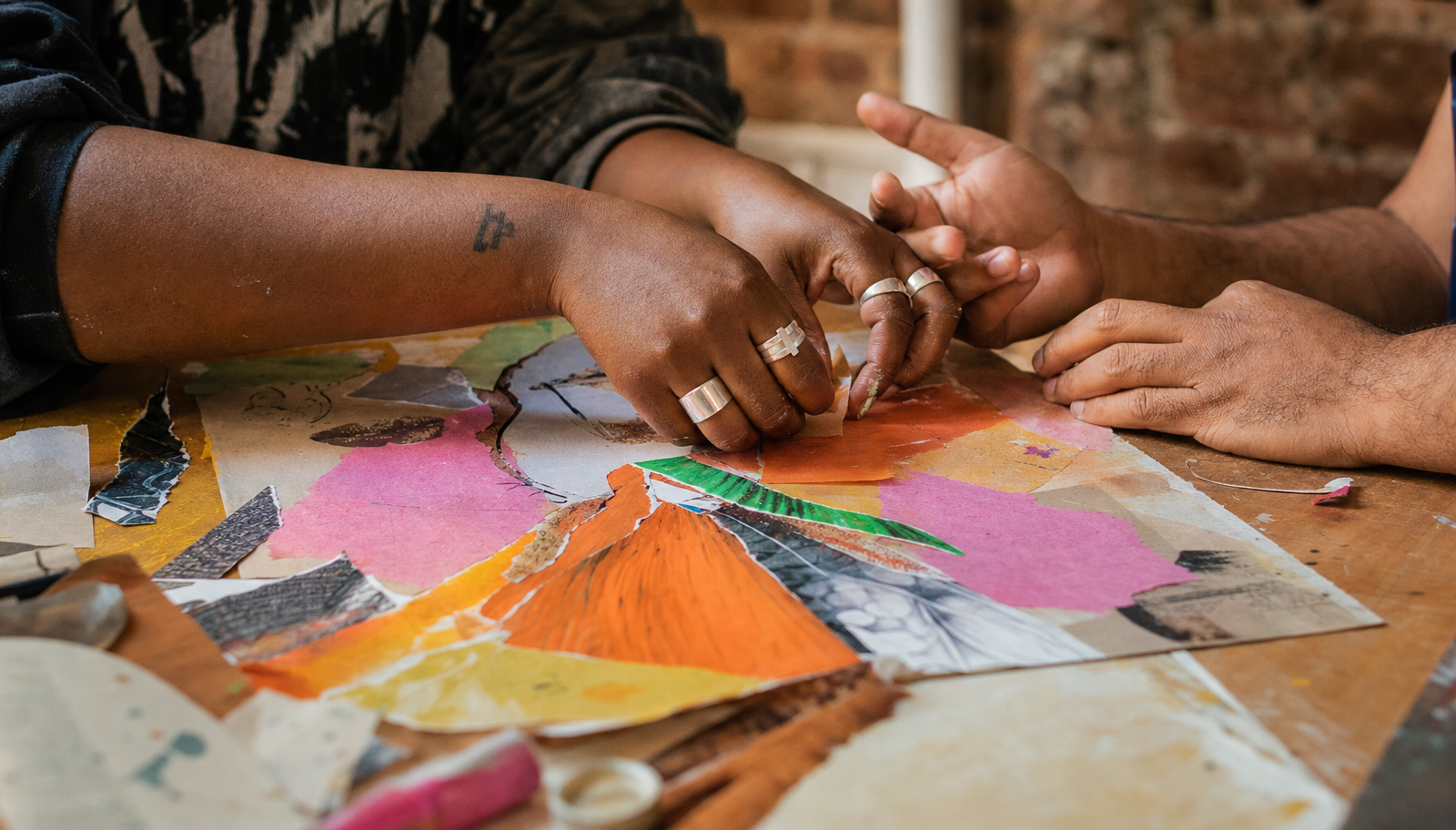
Here's the short version. Art therapy is making something with your hands and then making sense of it with a trained therapist in the room with you. The art gets what's hard to say out of your body and onto the table, where the two of you can actually look at it. What turns that from therapeutic into therapy isn't the materials — it's the person across from you and what they do with whatever surfaces. (You can see how we work across the whole art therapy practice, but this page is about the how.)
That one distinction is the whole thing, so let's take it slowly.
What actually happens in a session
You walk in. There's no blank-canvas pressure and no critique waiting. Your therapist offers a starting point — sometimes an open invitation, sometimes something specific to where you are that week — and you make something. Paint, collage, clay, charcoal, marker. Whatever lets the thing in you find a shape.
Then you look at it together. Not to decode it like a Rorschach card — to notice. What you reached for. What you avoided. Where your hand sped up, or went still. The image holds the feeling at a workable distance, so you can turn it over without being flooded by it. This is somatic work — what you already know, in your hands, before it's in words.
That's the part most descriptions miss: the making isn't the treatment. The making is what gives the two of you something real to work with.
Making art at home vs art therapy
Here's the honest line. Making art at home is good for you — keep doing it. But it's closer to journaling than to therapy, and the difference is the same one between writing in your notebook at midnight and sitting in a session.
When you journal, you're the only one in the room. You write the hard thing, and then you're alone with it. Sometimes that's enough. Often you circle the same loop, or you close the notebook the moment it gets too intense — because there's no one there to help you know what to do with it. Art at home works the same way: real relief, real value, but you're holding it by yourself.
A session is different because someone trained is tracking what you can't track on your own. When the work surfaces something big, you're not left carrying it alone. That's the move home art-making can't make — not because your art is lesser, but because there's no second person reading the room.
It's worth saying plainly: art therapy can feel weird at first. Making something in front of another adult, on purpose, about your actual life — that's not nothing. It's also exactly where the work happens.
Why the therapist in the room matters
So what is the therapist actually doing while you make a mess?
They're reading the process, not the product. They notice when you go quiet, when an image lands harder than you expected, when it's time to slow down and when it's worth staying with something uncomfortable a little longer. They keep you inside what's clinically called your window of tolerance — close enough to the hard material to do the work, far enough that you don't get overwhelmed. They hold the structure so you don't have to.
This isn't a soft extra around the real work. Across nearly 300 studies and tens of thousands of clients, the strength of the relationship between therapist and client is one of the most consistent predictors of whether therapy helps at all — steadier than the particular method used (Flückiger et al., 2018). The relationship isn't the nice part around the work. In a real sense, it is the work.
Our therapists are licensed creative arts therapists (LCAT) and credentialed art therapists (ATR, ATR-BC) — not talk therapists who keep crayons in a drawer. A lot of us make things ourselves; this is a practice we live in, not a language we borrowed. You can read more about what an art therapist is and meet the team.
What art therapy helps with
People come to the room for a lot of reasons, and the work holds up across them. Art therapy is used for anxiety, depression, and trauma and PTSD, often alongside other evidence-based work like EMDR. The art gives you a way in when words run out — which tends to be exactly when this is hardest to talk about.
Do you need to be good at art?
No. And we mean it — stick figures, scribbles, one color over and over again, fine. Skill isn't the point, and no one is grading it. The work lives in the making and the noticing, not in whether the thing is any good. If anything, the urge to make it "good" is usually the part we gently set down. Process over product. The mess is the point.
Does art therapy actually work?
Fair to ask, and we'd rather answer it straight than oversell. Art therapy is an established, evidence-based practice — not a craft hour, not a wellness trend. It won't fix things immediately, and some weeks will feel slow or strange. But making something real and working it through with someone trained to help you hold it does more than either piece could alone. Therapy is hard. Art therapy can feel weird at first. Both are worth it.
Starting art therapy at Brooklyn North
If you're curious, a first session is mostly low-key: a conversation about what brings you in, a look at how we work, and — if you're up for it — something small with your hands. No pressure to perform, no art experience required, no right way to do it. You bring yourself; we'll bring the materials and the room. Book a first session whenever you're ready.
Not ready for one-on-one sessions yet? Our are small, in-person sessions that show you what art therapy is and how a session works.
FAQ
-
No. The making is part of it, but art therapy is making something and working it through with a trained therapist in the room. The art surfaces what's hard to say; the therapist helps you make sense of it. Doing art on your own is therapeutic — art therapy is therapy.
-
At home, you're the only one in the room — it's closer to journaling. In art therapy, a trained therapist tracks the process with you, notices what you can't notice yourself, and helps you stay with hard material safely. The relationship is the difference.
-
No. No skill, no experience, no talent required. Stick figures and scribbles are completely fine. The work is in the making and the noticing, not in the result.
-
Yes — it's an established, evidence-based practice. And decades of research show the strength of the therapist–client relationship is one of the most consistent predictors of whether therapy helps, which is exactly what art therapy is built around.
-
They offer a starting point, give you room to make something, then look at it with you — reading your process, noticing shifts, and keeping you in a workable range so the hard parts stay manageable. They're trained, credentialed clinicians (LCAT, ATR-BC), not art teachers.
-
Anxiety, depression, trauma and PTSD, and more — often alongside other approaches like EMDR. It's especially useful when words run out and you need another way in.
