
Some feelings don't organize themselves into sentences. You sit down to write about your week and nothing comes, or what comes out reads flat compared to what's actually moving through your body. Art journaling works underneath that problem. It's the practice of putting marks, color, and scraps of your day onto a page - no drawing skill required, no finished product expected. For many people it's the most accessible way into making things with your hands, and one of the gentlest ways to notice what you're feeling before you can name it.
What Is Art Journaling?
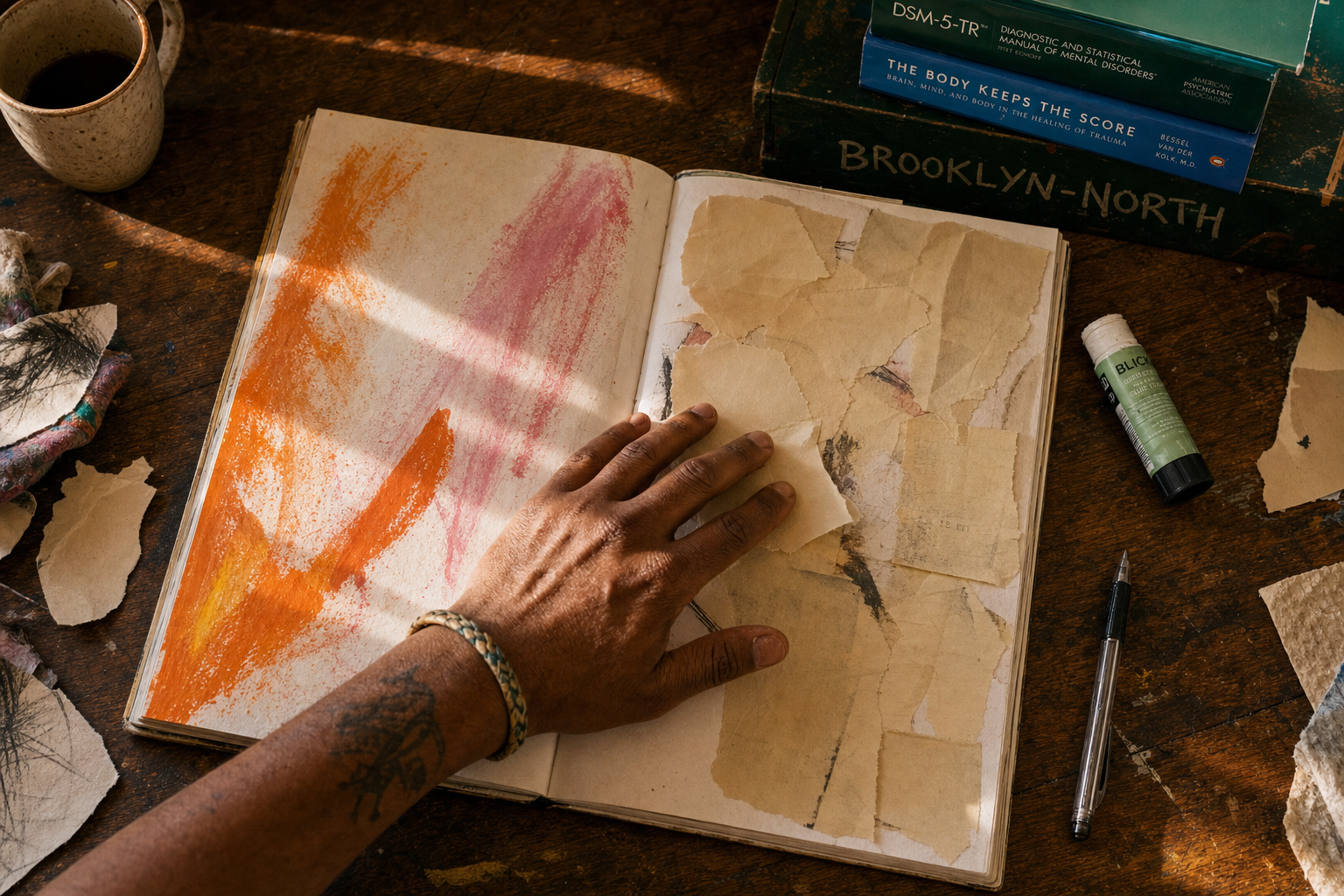
An art journal is a notebook you fill with whatever gets the inside onto the page: sketches, fields of color, collage, one angry scribble, a bus ticket taped next to three words. A written journal asks what happened and how you feel about it. An art journal lets the answer arrive as image, texture, and mark first - words optional.
Some people call it visual journaling. Whatever the name, it shares one thing with art therapy: the art is a form of expression, not a performance. The page isn't for anyone else. Nobody grades it. The mess is the point.
Art Journaling vs. Art Therapy: What's the Difference?
Art journaling is something you do on your own. Art therapy is something you do with a trained clinician, and the difference is bigger than it sounds.
An art therapist is trained in the materials themselves - in how a medium acts on you while you act on it. You're influencing the medium, and the medium is influencing you. Watercolor spreads and refuses control. Clay pushes back. A pencil stays precise and containable. If you're anxious, a runny, unpredictable material can leave you more unsettled than when you sat down. Part of how art therapy works is knowing which material to offer, and when. When you're not ready, the wrong medium doesn't just fall flat - it can throw you further into what you're carrying instead of helping you hold it.
This is also why art exercises borrowed into regular talk therapy don't always land. A therapist without training in the medium can hand someone a prompt that opens more than that person can close in the time left, and they leave the session flooded. It's a real skill to know the difference, and it's what an art therapist is actually trained to do.
Lastly, art therapy is artwork made with an art therapist present; they will interact with you during the making and after, which changes the impact - far beyond just choosing materials. Just like journaling on your own isn’t the same as talking to a verbal therapist, art making on your own isn’t the same as art making with an art therapist, because the therapist is trained to cull meaning and provide support when the moment calls for it.
None of this means skip the journal. It means an art journal is a self-led practice with real limits, and knowing those limits is what makes it safe.
How to Start an Art Journal
You need less than you think. Art journaling for beginners mostly means lowering the bar until you actually begin.
Pick a notebook you're willing to ruin. A beautiful sketchbook invites precious, careful pages. A cheap one invites honesty.
Start with what's in your bag. Just a pen is enough. You can add materials later, or never.
Let collage do the work on hard days. Cutting and arranging asks less of you than drawing. Receipts, magazine scraps, packaging - all of it counts.
Set a timer, not a standard. Ten minutes. When the timer ends, you're allowed to stop, even mid-mark.
Date the page and close the book. No flipping back to judge yesterday's page. The journal is a record, not a portfolio.
Art Journal Ideas and Prompts to Try
When the blank page stares back, borrow one of these art journal prompts:
Draw your day as weather.
Fill a page with the color your week felt like.
Trace your hand and fill it with everything it's been holding.
Make the ugliest page you can, on purpose.
Draw the knot in your chest or stomach: its size, texture, and color.
Draw your day in one continuous line without lifting the pen.
Scribble hard for one minute, then find shapes inside it and outline them.
Paint or color straight over an old to-do list.
Collage the contents of your pockets or bag.
Draw the room where you feel safest.
None of these require skill. They require ten minutes and a closed door.
Why the Medium Matters
Materials have temperaments, and your nervous system responds to them whether you notice or not.
Pencil and pen offer control. Lines stay where you put them. Good when you feel scattered and need containment.
Markers commit. Bold, permanent, no undo. Good for saying something plainly.
Collage lets you arrange instead of generate. Good when making anything from scratch feels like too much.
Watercolor and ink move on their own. They ask you to give up control - grounding for some, genuinely destabilizing for others, especially mid-anxiety.
A useful rule for a self-led practice: when you're activated, reach for structure. When you're numb or stuck, reach for something looser. And if a material consistently leaves you worse than it found you, that's information - the kind an art therapist reads all day.
What Art Journaling Can and Can't Do for Your Mental Health
Art journaling for mental health has honest, modest benefits: it slows you down, it puts feelings outside your body where you can look at them, and over months it becomes a record of patterns you'd never spot day to day. Therapeutic journaling of any kind - written or visual - is one of the cheapest regulation tools there is, which is why the American Art Therapy Association draws a clear line between art as self-care and art therapy as clinical treatment.
What a journal can't do is process trauma on its own, or catch you when a page opens something heavy. If your journal keeps circling the same dark material, or you often feel worse after making than before, that's the signal to bring the work into a room with a clinician - for example, art therapy for anxiety picks up exactly where the self-led version hits its ceiling.
Therapy is hard. Art journaling can feel awkward at first. Both are worth it.
FAQ
Do I need to be good at art to keep an art journal?
No. The journal measures honesty, not skill. Stick figures and scribbles do the job completely.
What supplies do I need to start art journaling?
A notebook and a pen. Genuinely. Collage materials, markers, or paint can come later if you want them.
Is art journaling the same as art therapy?
No. Art journaling is self-led; art therapy is clinical treatment with a trained, licensed therapist who knows how materials affect you and paces the work accordingly.
How often should I use an art journal?
Whatever you'll actually do. Ten minutes a few times a week beats an ambitious daily plan you quit in February.
Can art journaling help with anxiety?
It can help you notice and regulate day to day. For anxiety that's interfering with your life, it works best alongside therapy rather than instead of it.
What if making art makes me feel worse?
Stop, switch to a more contained material (pen over paint), and take it seriously as a signal. If it keeps happening, that's a good moment to talk to an art therapist.
Curious what the guided version feels like? Get started with Brooklyn North - we'll match you with a therapist and you can bring the journal. Or start with a small and see how the guided version works in the room.
